
An enduring memory of my childhood is my brother forensically going over every present under the Christmas tree. Was it lego? Which DVDs were in this one? How much chocolate were we getting? He would try everything short of actually ripping off the wrapping paper. My sister has been known to weigh presents as part of her detective method! I suppose we’re a family that doesn’t like waiting. But then who does?
Imagine setting all your hope in something and then waiting, waiting – not for a few days, months or even years – but for your whole life! That sense of deep longing is the thought behind this week’s carol.
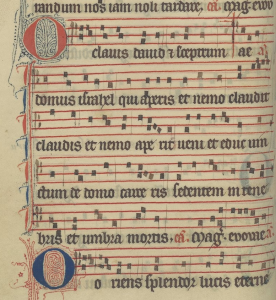
Part of the Great Advent Antiphons which O Come, O Come, Emmanuel paraphrases (By Castorepollux.Ordre des prêcheurs – Gallica)
The words to O Come, O Come, Emmanuel go back a long way, probably originating in the 8th or 9th century, making this song over 1,200 years old. Originally written in Latin (“Veni, Veni Emmanuel”), it is traditionally sung during the last week before Christmas.
John Mason Neale’s translation in 1851 was the start of this song becoming a popular carol. For a long time, no one knew where the tune we sing this carol to (known as “Veni Immanuel”) had come from. Then in 1966 British musicologist Mary Berry (nothing to do with cakes!) discovered it in a 15th-century manuscript. Turns out the tune was originally written to be a processional chant for burials!
Much of the language is archaic and difficult to understand. Add to that a dark, gloomy tune and you get an odd carol for Christmas – a time of year when we sing about being “merry and bright”. I think it works though. It has a gravitas about it and captures a sense of deep longing and waiting.
Here’s the version of the carol that you’re most likely to hear today. Each verse contains at least one title for this Emmanuel. Let’s take a look:
O come, O come, Emmanuel,
And ransom captive Israel,
That mourns in lonely exile here,
Until the Son of God appear.
Rejoice! Rejoice! Emmanuel
Shall come to thee, O Israel.
Emmanuel or Immanuel means “God with us”. Ancient Jewish history tells of two times when the nation was held captive far away from their homeland – once in Egpyt and then much later in Babylon. There they waited for their Creator-God to come, set them free and lead them home.
The Bible says in a sense we’re in exile too. The same God ancient Israel was waiting for is the One we were created to worship, know and enjoy. All our wrongdoing, guilt and pride has ruined that relationship. We need Him to come and rescue us from our self-inflicted exile.
O come, Thou Rod of Jesse, free
Thine own from Satan’s tyranny;
From depths of hell Thy people save,
And give them victory o’er the grave.
Rejoice! Rejoice! Emmanuel
Shall come to thee, O Israel.
O come, Thou Dayspring, from on high,
And cheer us by Thy drawing nigh;
Disperse the gloomy clouds of night,
And death’s dark shadows put to flight.
Rejoice! Rejoice! Emmanuel
Shall come to thee, O Israel.
Rod of Jesse – In the Book of Isaiah it is said Emmanuel would be a rod (growing from the root) of a man called Jesse. In other words, Jesse would be the great, great (many times over) grandfather of Emmanuel. This was all predicted many hundreds of years before Jesus of Nazareth was born into this same family.
Jesse was also the father of the great jewish king, David. King David is famous as the man who defeated all Israel’s enemies and ushered in a time of peace. The Bible’s books of 1st and 2nd Samuel tell the story of David’s adventurous life.
The Bible also says we face enemies which could destroy us in the end. It claims that there is a dark personal force at work in this world. This is what the carol means by “Satan” – a word which means “adversary”. Because our relationship with our Creator has been broken, we’re open to being manipulated, hardened and drawn away into a life of darkness, hopelessness and, in the end, dispair.
Death too is called an enemy in the Bible. Death isn’t a natural thing, it’s an intruder and we’re afraid of it – or rather our consciences make us afraid of what lies beyond death. Our wrongdoing may not seem a big deal to us, but humanity is the only part of creation that refuses to obey its Maker. We’re committing cosmic treason every day. Because of our wrongdoing and because God is good, holy and just, we can expect Him to punish us. Beyond death we face His justice. But there is hope…
Dayspring – Jesus said that He was the light of the world. Just like when first rays of daylight break through the darkness of night, so Jesus said He came to break through the darkness in our hearts and lives. He alone can truly set us free from the darkness of guilt, untruths and fear of death. He came to show us what truth is. He came as a man to deal with our guilt by taking our punishment in our place, so that the justice of God is already satisfied and there is nothing left to fear beyond the grave. Now that’s cause for rejoicing!
O come, Thou Key of David, come
And open wide our heav’nly home;
Make safe the way that leads on high,
And close the path to misery.
Rejoice! Rejoice! Emmanuel
Shall come to thee, O Israel.
O come, Adonai, Lord of might,
Who to Thy tribes, on Sinai’s height,
In ancient times didst give the law
In cloud and majesty and awe.
Rejoice! Rejoice! Emmanuel
Shall come to thee, O Israel.
Key of David – The person who has the key to something gets to decide if it stays open or closed. Just like King David, Emmanuel is a King. But Emmanuel is a far greater King then David. He holds the keys to heaven and hell. He came to be the way back to God and to open the door to heaven for us.
Adonai is an ancient title for God. It means “Lord” or “the Sovereign One”. On Mount Sinai, the Creator-God of heaven and earth – Adonai – gave out His 10 commandments, His top-ten rules for us to live by. As the maker and owner of all things, He has the authority to define what is right and wrong. This God of terrifying majesty and awe laid aside His glory to become the child of a peasant girl, and His first bed on earth was a manger – an animal feeding trough.
Why did He humble Himself so completely? Out of sheer mercy – to rescue, heal and restore us. No wonder His coming brings joy!
I am the light of the world. Whoever follows me will not walk in darkness, but will have the light of life…
Truly, truly, I say to you, whoever hears my word and believes him who sent me has eternal life. He does not come into judgement, but has passed from death to life.